


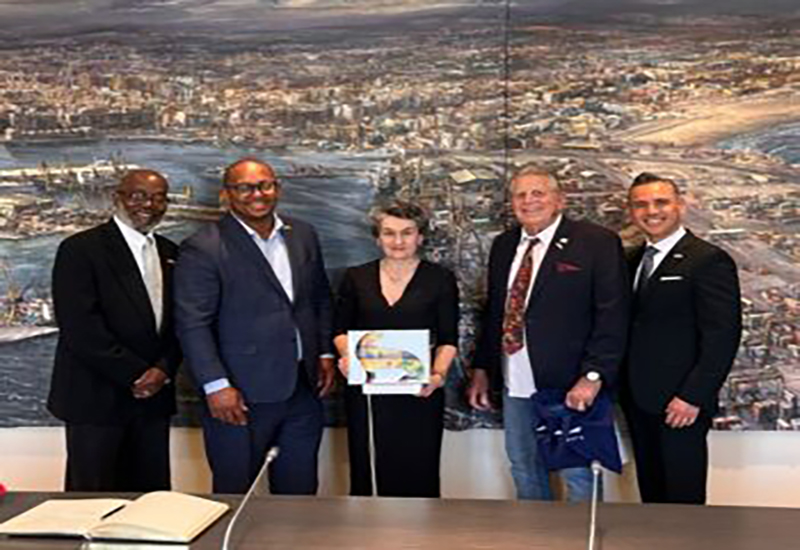

Long Beach delegation visited the Port of Valencia in Spain recently to discuss collaborating to advance sustainability and decarbonisation goals. From left: Long Beach Harbour Commission Vice President Steven Neal, Long Beach Mayor Rex Richardson, Port Authority of Valencia President Mar Chao, Long Beach Harbour Commission President Frank Colonna and Port of Long Beach CEO Dr. Noel Hacegaba.
Further content is only available for registered users.
A delegation from the Port of Long Beach visited the Port of Valencia, Spain to identify ways the two entities can collaborate and advance shared goals in sustainability, decarbonisation and the development of green corridors.
During the working meeting, both parties discussed the importance of strategic partnerships to facilitate exchanges of information and technology related to cleaner operations, as well as a mutual desire to formalise a green partnership.
“Valencia and Long Beach share the goal of a zero-emissions future, challenging us to meet climate goals and reduce impacts on our respective communities,” said Long Beach Mayor Rex Richardson, who led the delegation consisting of Port of Long Beach CEO Dr. Noel Hacegaba and Long Beach Harbour Commission President Frank Colonna. “Our collaboration can serve as a global example to decarbonise trade and develop a cleaner supply chain while still driving economic growth.”
The Port of Long Beach has unveiled a bold, new 2050 vision and a plan to double current container volumes to 20 million annually by 2050, while continuing to lead the world on sustainability programmes.
A green corridor agreement with the Port of Valencia would add to the list of other global partnerships the Port of Long Beach has struck to advance environmental objectives, with memorandums of understanding signed with representatives in Singapore, Kobe, Shenzhen and elsewhere.
“We are building the Port of the Future in Long Beach, with industry-leading infrastructure that moves cargo faster and more sustainably,” said Hacegaba. “Like the Port of Long Beach, the Port of Valencia is a global leader and we welcome closer collaboration with them as we accelerate decarbonising global trade routes in the years ahead.”
“The Port of Long Beach is on its way to becoming the world’s first zero-emissions port, and we continue to be a model for ports worldwide with our push for green shipping corridors, the newest strategy to decarbonise trade,” said Colonna. “These corridors are particularly important when it comes to reducing shipborne emissions, the largest single source of pollution associated with seaports.”
In 2005, the Port of Long Beach adopted the Green Port Policy, a commitment to reduce the negative impacts of operations. A year later, the Port teamed up with the Port of Los Angeles to create the Clean Air Action Plan, a comprehensive strategy updated in 2017 to accelerate progress toward a zero-emissions future while protecting and strengthening the ports’ competitive position in the global economy.
The Port’s most recent emissions inventory found that these sustainability programs since 2005 have cut diesel particulate matter by 90%, nitrogen oxides 68% and sulfur oxides 98% while cargo volumes increased 44% during the same period.