


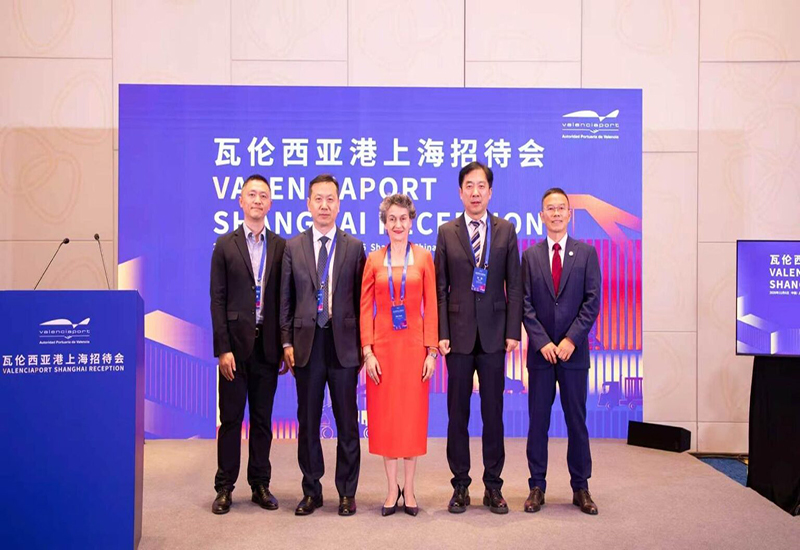

Shanghai International Port Group (SIPG) and Valenciaport organise a joint presentation to their clients on the opportunities for business development.
Thus, Valenciaport and Shanghai International Port Group (SIPG) held a meeting at the Shanghai Tower. The event was chaired by Mar Chao, President of Valenciaport and Sam Liu, Vice President SIPG, who were joined by CSP Spain CEO Guoqiang Shi. The meeting provided an opportunity to highlight the business opportunities between the two ports and reinforce the collaboration in deploying green corridors.
China is Valenciaport’s largest international market in terms of container traffic. Between January and September 2026, a total of 714,691 TEUs were handled in trade with the Asian country, representing a 15.07% increase compared to the same period of the previous year. In terms of tonnes, cargo traffic with China reached 7.66 million tonnes, a 15.75% increase.
Specifically, the Port of Shanghai accounts for 36% of trade between Valenciaport and China, representing 2.3 million tonnes per year.
Further content is only available for registered users.
“Our strategic location in the Western Mediterranean makes us one of the main gateways for goods moving between Asia, Spain and the rest of Europe,” emphasised the President of Valenciaport, who highlighted connectivity as one of the “main strengths” of the APV’s port infrastructure, with more than 100 regular shipping services connecting to all five continents.
A strategic relationship for Valenciaport
“China is one of Valenciaport’s most important trading partners, and we want to continue strengthening a relationship that is already strategic for our port,” said Mar Chao, who expressed her conviction that there is still “great potential for collaboration” between the two regions.
The aim of this visit is to give Chinese companies a first-hand understanding of the advantages Valenciaport offers as a gateway to the Spanish and European markets. The APV’s ports benefit from extensive maritime connectivity, rail links to major logistics and industrial hubs, and a hinterland that accounts for a significant share of Spain’s economic activity. The figures speak for themselves: Valenciaport handles more than 40% of Spain’s total import and export traffic.
According to the President of the APV, these advantages make Valenciaport a “reliable and competitive partner, capable of supporting their international growth.”
Sustainability and green corridors: a priority
Digitalisation, innovation and sustainability are three key areas in which the APV aims to strengthen cooperation with China, as ports will no longer compete solely on their capacity to handle cargo, but also on their efficiency, connectivity and ability to develop smarter and more sustainable logistics chains.
In this regard, Valenciaport has been working for years on the digitalisation of its operations as well as on the energy transition. The Net Zero Emissions Plan sets the goal of achieving net zero emissions by the middle of the next decade, and initiatives related to electrification, renewable energy and shore power supply to vessels are already being developed and implemented.
Mar Chao, also attended the China International Import Expo (CIIE) in Shanghai, where she met with representatives of the Chinese logistics, port and business communities, with the aim of strengthening Valenciaport’s visibility and positioning in the region.