


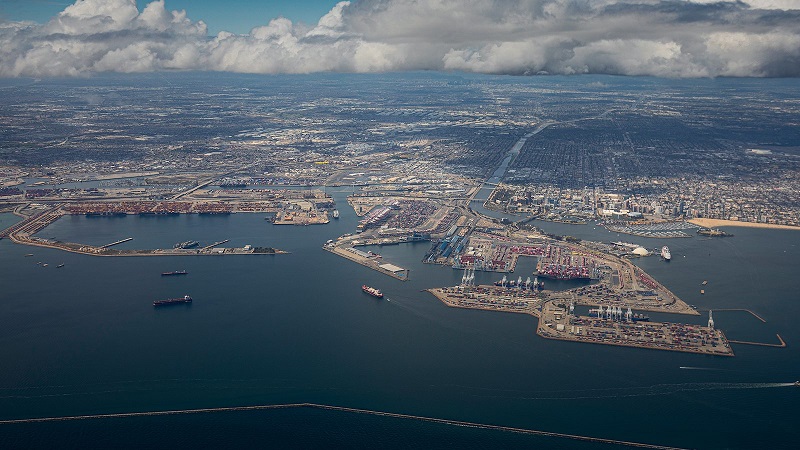

During his first State of the Port address, the Port of Long Beach’s newly appointed CEO Dr Noel Hacegaba announced that the port handled a total of 9,881,595 TEUs in 2025, surpassing the previous record of 9.6 million TEUs set in 2024 by 2.4%. Moreover, the milestone without the backlog and yard gridlock that haunted the San Pedro Bay during the pandemic surge.
Further content is only available for registered users.
Imports inched up 1.1% to 4,779,559 TEUs, while exports fell 5.5% to 1,141,113 TEUs, underscoring the persistent imbalance in US trade. Empty container moves jumped 6.7% to 3,960,925 TEUs. For the first time, five of the port’s six terminals each handled more than 1 million TEUs, with two topping 2 million.
“We have 24 years to prepare to double our container throughput and figure out how we’re going to handle all that additional cargo quickly, safely, efficiently and sustainably,” said Hacegaba during the address at the Long Beach Arena.
The growth plan leans heavily on rail. The US$1.8 billion Pier B On-Dock Rail Support Facility – scheduled for 2032 completion – aims to move containers from ship to train in under 24 hours and triple on-dock rail volumes to 4.7 million TEUs. “Speed to market is the key to our success and rail connectivity is the key to our future,” said Hacegaba.
Long Beach is also pitching what it says would be the world’s first conventional zero-emissions container terminal. The proposed Metro Express Terminal at Pier S would handle up to 1.8 million TEUs annually using human-operated, renewable-powered cargo equipment – a project that will test how far electrification can go at scale.
On the digital front, the CargoNav platform – an evolution of the Supply Chain Information Highway – will soon add a Universal Trucking Appointment System designed to let carriers book pickups and drop-offs across all six terminals, a long-sought step toward smoothing truck turn times.
Hacegaba took over as CEO on January 1, succeeding Mario Cordero after 15 years in senior port roles. He led the Business Recovery Task Force during COVID and later oversaw development of the information-sharing tools that became CargoNav. For 2026, the port expects another 9-million-plus year as shippers navigate tariff normalization and shifting sourcing patterns. Long Beach now handles 48.9% of the cargo moving through the San Pedro Bay complex, a share officials expect to keep climbing.