


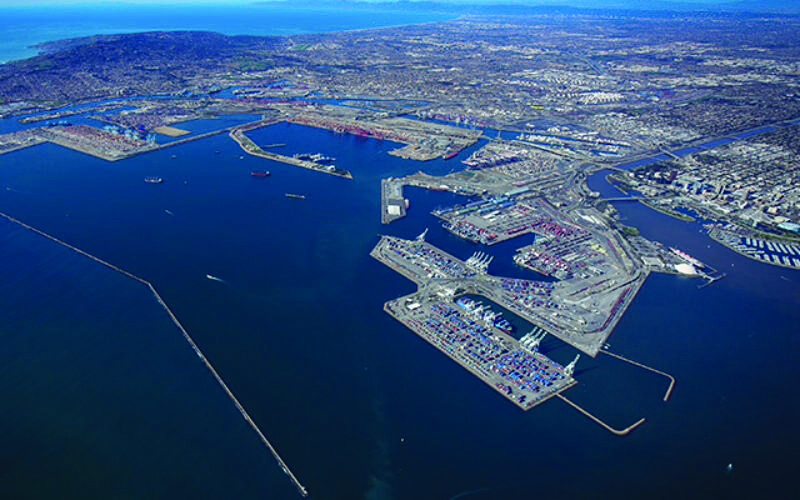

At his inaugural State of the Port address in January, Hacegaba kicked off 2026 with a Gibson Les Paul electric guitar in hand, his trademark pocket square expertly tucked into his suit jacket, and a bold plan dubbed 2050 Vision for readying the Port to double its current container volume without slowing its drive to zero emissions. By the numbers, it means positioning the Port to handle 20 million TEUs by 2050, up from nearly 10 million TEUs in 2025.
At “halftime,” Hacegaba reports his team is gaining yardage on infrastructure, innovation and sustainability projects as it moves toward the goal line. In the process, Hacegaba sees himself as a coach of a championship team playing to win.
Further content is only available for registered users.
Tie Lines: 2050 Vision is an ambitious plan. Why is it needed?
Dr. Noel Hacegaba: First of all, it was important to send a strong signal to our customers and partners that the Port of Long Beach is bullish on the future. Second, having a long-term vision brings alignment inside the organisation and across the supply chain and gives us the runway to plan our investments and infrastructure projects accordingly. Third, I wanted to give our Port of Long Beach community something to look forward to beyond the present-day trade disruptions and geopolitical uncertainty. Over the next 10 years, the Port of Long Beach is investing $3.3 billion – the single largest capital infrastructure programme of any port in the world – which means we’re not just signalling we’re the Port of the Future, we’re literally building the Port of the Future.
TL: How has the industry responded?
NH: Our bold new vision has been met with great enthusiasm across the board. Our labour partners like it because cargo growth creates more jobs and opportunities for economic prosperity and upward mobility. The CEOs of ocean carriers appreciate the forward-thinking approach and growth mindset. They tell me they want to grow together with us. And our other partners, including the regional planning agencies, like it as well because it helps them plan their own infrastructure investments to support the region’s transportation system.
TL: As the saying goes, expect the unexpected. One “unexpected” since you took the helm of the Port on Jan. 1 has been the ongoing Iran conflict that started in late February. How is the Port of Long Beach meeting the moment?
NH: I knew coming into this role that the only certainty was more uncertainty. I was focused on changes in trade policy, specifically the pending U.S. Supreme Court decision on the International Emergency Economic Powers Act (IEEPA) tariffs. What I don’t think anyone saw coming was the conflict in the Middle East, which is the single most unexpected event to happen so far this year. The Port of Long Beach and our broader port community have flexed our resilience muscles to meet the moment by serving as a safe harbour in the sea of trade and geopolitical uncertainty. As a result, we led the nation in container volume the first quarter of this year, and our overall cargo volume is up nearly 2% for the first six months of 2026 compared with the same period for 2025. We have demonstrated our ability to adapt, pivot and provide the resilience, reliability and continuity that our customers have come to expect from the Port of Long Beach. For that reason, we were voted the Best West Coast Seaport in North America by Asia Cargo News for the eighth consecutive year.
‘Halftime’ Highlights
Port accomplishments January-June 2026 under CEO Dr. Noel Hacegaba
- Advanced construction of the $1.8 billion Pier B On-Dock Rail Support Facility.
- Proceeded with Deep Draught Navigation Project to deepen and widen key Port waterways for better and safer navigation in partnership with the US Army Corps of Engineers.
- Moved forward with wharf improvements to Pier G and adding new inbound truck lanes to Pier E.
- Advanced design and environmental reviews for improving Pier T and Pier A West.
- Moved forward with designs for zero-emissions infrastructure at Piers A and J.
- Launched CargoNav, the Port’s new digital hub for shippers and supply chain partners to better plan, schedule and track cargo.
- Opened the Port’s Cyber Defense Operations Center.
- Established partnerships with trucking companies to launch two Green Truck Corridors – one connecting the Port to the Central Valley, and the other connecting the Port to Mexico.
- Established a $4.8 million awards program to recognise early adopters of zero-emissions trucks keeping their vehicles in Port service.
- Created a $1 million award for the first ship to refuel with methanol at the Port.
- Awarded nearly $400,000 in scholarships and more than $2 million in community sponsorships.
Additional highlights: During his first six months as CEO, Hacegaba represented the Port on the world stage at the World Economic Forum in Davos, Switzerland, was elected president of the California Association of Port Authorities (CAPA) and welcomed California Secretary of Transportation Toks Omishakin to the Port.
TL: You’ve described the Port of Long Beach as the intersection of global trade, geopolitics, technology and climate change. How is the “Port of the Future” shaping the future on these fronts?
NH: The Port is ground zero for all of these forces. I say this because trade policy, geopolitics, technology and climate are all reshaping the world as we know it and converging at ports like ours. In global trade, we’re shaping the future by investing in infrastructure like our Pier B On-Dock Rail Support Facility and building resilience and efficiency in our operations. With our new CargoNav digital initiative, we are deploying advanced technology to help our customers and supply chain partners gain real-time visibility and better plan, schedule and track cargo. Likewise, our new Cyber Defense Operations Center fortifies our critical data networks. When it comes to environmental sustainability, we’ve been leading the way for more than 20 years and we have launched new, innovative initiatives such as the world’s first port-powered Green Truck Corridors and our $1 million methanol challenge just in the last six months. By building the Port of the Future, we are future-proofing our Port and redefining port operations.
TL: Building doesn’t mean expanding the size of the Port, right?
NH: That’s exactly right. Doubling our throughput doesn’t mean we’re going to double our real estate. No. 1, it’s too expensive. No. 2, it would take too long. In order to get to the Port of the Future, we have to densify, electrify and modernise our Port. And as we build the Port of the Future, we will also prepare the workforce of tomorrow by leveraging strategic partnerships such as our education initiatives with the Long Beach Unified School District and higher institutions and our internal professional development programmes such as our recently launched Port of Long Beach University. We can talk about policies, programmes and projects all day long, but ultimately, it’s the people who power the Port. The surest way to move our port forward is by investing in our people, developing our people and empowering our people.