


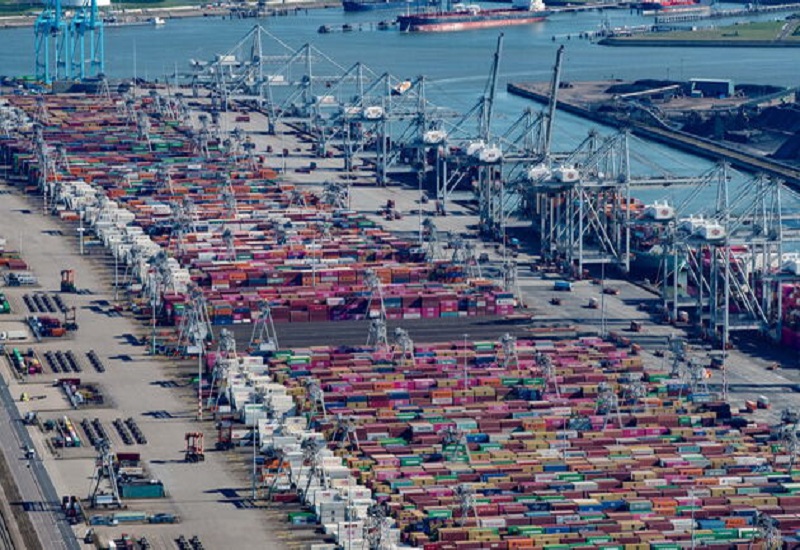

The Dutch recognise the importance of container transport but underestimate their dependence on it.
Sixty years after the introduction of the container, many Dutch people are still unaware of how much we rely on container transport. This is revealed by new research commissioned by the Port of Rotterdam Authority and conducted among more than 1,500 respondents. Containers are still often seen as ‘boxes full of stuff’, whereas in reality they play an essential role in everyday life and the economy. Without the container, the Dutch economy would largely grind to a halt.
Further content is only available for registered users.
On 3 May 1966, the very first container ship arrived in the port of Rotterdam. Since then, container transport has developed into a global system that makes a significant contribution to prosperity, security of supply and economic development in the Netherlands and Europe. Thanks to container shipping, products from all over the world are readily available: from medical supplies at the pharmacy to fresh produce in the supermarket. Container transport has thus become one of the Netherlands’ silent successes. The research shows that there is a great deal of trust in a system that is deeply intertwined with our daily lives
The survey shows that more than half of Dutch people (54%) believe they are not dependent in their daily lives on goods that enter the Netherlands via containers, or are dependent only to a limited extent. At the same time, two in five Dutch people (40%) expect a temporary shutdown of the port of Rotterdam to have a major impact on their daily lives. The level of dependence is high, but it is not perceived as such.
Bart Kuipers, Port Economist, Erasmus University Rotterdam: “The discrepancy between perception and reality in this study is striking: many people underestimate their dependence on container shipping, even though container flows form the backbone of both our imports and exports, and thus of our economy and society.”
The importance is recognised, but knowledge is limited
According to four out of five Dutch people (81%), container logistics is (very) important for the Dutch economy. At the same time, a quarter (27%) say they are completely unfamiliar with container transport, whilst 46% are only somewhat familiar with it. The general perception of containers is largely positive. Container transport is often regarded as efficient, reliable and of great importance to the economy.
At the same time, there are misconceptions about the contents of containers. For example, a third of Dutch people believe that containers mainly carry non-essential goods, whilst just under half of Dutch people believe that an equal amount of essential and non-essential goods are transported. In practice, the majority of container shipments actually consist of raw materials, semi-finished products and other essential goods. These form the basis for our food supply, healthcare, industry, energy and much more.“Virtually everything we use on a daily basis has been transported in a container: from our groceries to products used in the healthcare sector”, says Hanna Stelzel, Director of Containers at the Port Authority. “The container is the silent backbone of our prosperity. Because the system has become so much a part of our daily lives, we often no longer realise how dependent we are on it. Without containers, everyday life would simply grind to a halt. In the coming period, we will be focusing more on the importance of container logistics for our society.”
Heavy reliance on international chains
Two in five Dutch people (43%) believe that the Netherlands is capable of producing many of the goods that arrive by container. Furthermore, 37% believe that Europe will eventually be able to function without these imports, regardless of the economic consequences. In reality, many of these goods cannot be produced locally, or only to a limited extent, and Europe will remain dependent on international supply chains for the necessary raw materials and semi-finished products. Container transport therefore plays a key role in ensuring security of supply and the smooth functioning of international supply chains. Seven out of ten Dutch people (72%) expect the Netherlands to have sufficient reserves to cope with temporary disruptions. Some 6% believe that the Netherlands has sufficient reserves to cope with disruptions over a long period. However, if the supply chain comes to a standstill for an extended period, this can have a major impact on daily life. The effects are particularly noticeable in the case of fresh produce, building materials and semi-finished industrial products. Delays in the container supply chain mean that production processes come under pressure, preventing supplies from reaching shops, healthcare facilities and factories.
A key role in sustainability and the energy transition
Container transport also plays an important role in making the economy and society more sustainable. Just over three in five Dutch people (65%) believe the term ‘sustainable’ is appropriate for containers, and 46% consider container transport to be more sustainable than air transport. Solar panels, battery materials and industrial equipment are largely transported by container, and are essential for achieving sustainability. At the same time, opinions differ on the environmental impact: 23% see a negative effect and 21% a positive effect. This shows that there are different perspectives on the role of container transport within the sustainability debate. Thanks to electrification, alternative fuels and more efficient transport, container shipping remains not only a cornerstone of today’s economy, but also a key link in making society more sustainable.