


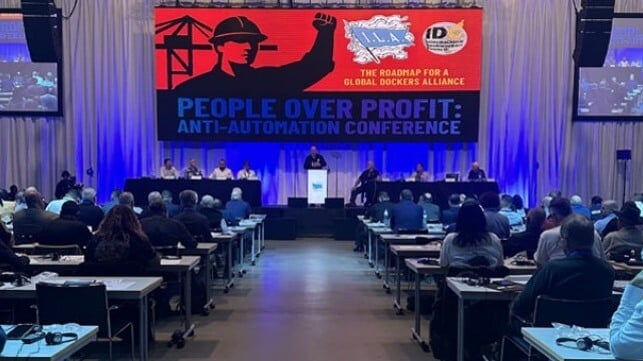

A two-day summit in Lisbon, Portugal, has brought together hundreds of trade union representatives from more than 60 countries alongside leaders, academics, and experts from the maritime and port sectors, showing their resistance against efforts by ports and terminal logistics operators across the globe to automate processes to enhance efficiency, thus killing dock workers’ jobs.
Further content is only available for registered users.
The group of unions report that a framework has been adopted to fight any efforts by ports to invest in automating operations. The framework was developed based on the unions’ assertion that automation does not modernise ports but is done to eliminate workers and maximise profits.
The summit, held under the banner of “People Over Profits: Anti-Automation” and jointly organised by the International Dockworkers Council (IDC) and the International Longshoremen’s Association (ILA), resolved to establish what is being termed a new Global Maritime Alliance. They report it will be committed to halting the expansion of automation in ports worldwide. The goal is to rally port workers across the globe to engage in coordinated strike actions.
In the resolution, the unions were categorical that they will fight any automation process that involves job losses or violations of rights. They went ahead to reaffirm collective bargaining as an essential tool to regulate technological changes in ports. In case ports decide to impose terminal automations without consultations and consent from unions, the union leaders report that dockworkers will act in a united and coordinated structure to paralyse operations.
Though the IDC and the ILA contend that the ports of the future must be modern, green, and efficient, they said it cannot happen at the expense of jobs. The unions are calling for port authorities across the globe to “craft a formula of integrating dock workers in their technological investments.”