


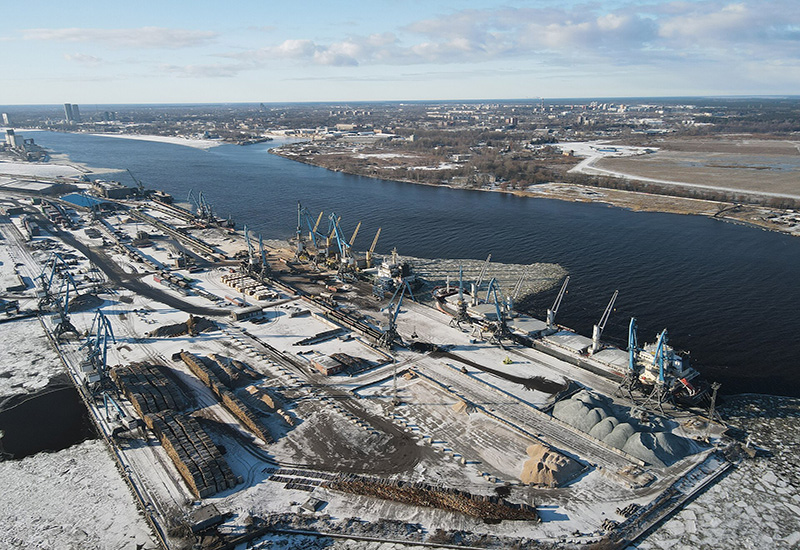

LVR Flote and HARDMODE have signed a Memorandum of Understanding (MoU) to develop and test secure communications technologies at the Port of Riga, targeting connectivity risks affecting port operations and critical maritime infrastructure.
The partners will use the port as a live testing environment for technologies designed to maintain communications when conventional networks are disrupted or unavailable.
Further content is only available for registered users.
The collaboration will involve pilot projects, joint research and development, and plans to commercialise successful solutions for deployment at other European ports.
HARDMODE develops multi-technology communications systems designed to connect sensors, personnel, vehicles, drones and infrastructure across environments where reliable connectivity is essential. The partnership will examine how mobile, non-terrestrial, tactical and narrowband communications can operate within a single ecosystem.
Artūrs Lindenbergs, Founder and Chief Executive Officer of HARDMODE, said: “Critical infrastructure is getting more demanding every year. As more sensors, vehicles and systems are connected, more of a port’s daily work stops when connectivity drops. Our approach has two parts.
“The first is layering: resilience cannot depend on a single technology, so we combine several, and when one is degraded, the others carry the traffic. The second is decentralisation: each node carries both the network and the software the use case needs, and the nodes connect directly to each other. The result is one solution rather than a set of systems someone has to integrate on site, and the Port of Riga is the right place to prove that in real operations.”
The project comes amid repeated global navigation satellite system (GNSS) interference incidents in the Baltic Sea region, which have affected shipping and port operations.
The partners aim to assess how communications systems using multiple technologies can reduce dependence on individual networks or infrastructure layers.
LVR Flote provides technical port services and supports infrastructure maintenance and operations at Riga. Potential applications include infrastructure monitoring, data management, navigation safety, maintenance and co-ordination between port stakeholders.
Kaspars Ozoliņš, Member of the Board of LVR Flote, stated: “Port technical services have to keep running in everyday operations and in a crisis alike. Together with HARDMODE, we want to explore how hydrographic surveys, infrastructure maintenance and coordination with other port stakeholders could continue even when conventional networks are disrupted. For us, this is what innovation, cooperation and development mean in practice: developing solutions based on real operational needs and growing stronger together.”
The partners also plan to establish an open testing framework for other technology companies developing products that depend on secure communications, including sensors, monitoring systems, automation and digital port services. The framework would allow developers to test how their technologies perform and interact in a live port environment.
The agreement also establishes a basis for cross-border research and development between Latvia and the Netherlands, where HARDMODE has roots. The partners intend to use results from the Riga pilots to pursue international projects and assess opportunities to expand successful solutions across European markets.
H.E. Carl Peersman, Ambassador of the Kingdom of the Netherlands to Latvia, said: “Resilient critical infrastructure and secure digital connectivity are vital for both the security and economic stability of Europe’s maritime gateways. As a proud country partner of the Techritory Forum, the Embassy of the Netherlands is pleased to see this collaboration take shape between Dutch-Latvian innovators like HARDMODE (Sentyiv B.V.) and Latvia’s LVR Flote.
“Using the Port of Riga as a real-world testbed underscores the strength of our bilateral innovation ties and our shared commitment to building robust, future-proof solutions for the entire European maritime sector.”