


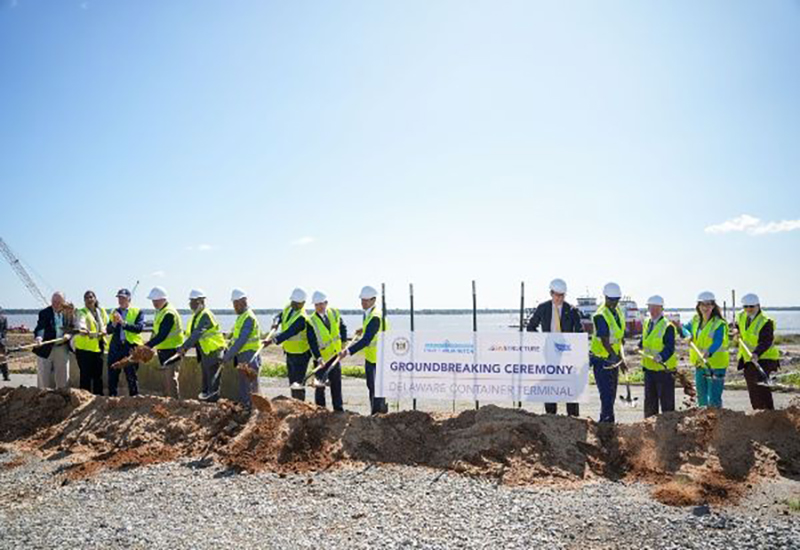

Enstructure and the Diamond State Port Corporation (DSPC) have broken ground on a new container terminal at the Port of Wilmington, Delaware, with the facility due to open in early 2029.
The project is being delivered via a public-private partnership between Enstructure and the State of Delaware. DSPC owns the site, while Enstructure is responsible for development and will operate the terminal under a long-term concession agreement.
The $669 million Delaware Container Terminal (DCT) is being developed at the former Edgemoor industrial site and is designed to nearly double container capacity across the Delaware River port complex.
Further content is only available for registered users.
The terminal will feature a 2,700-foot quay with a depth of 45 feet, enabling it to handle vessels of up to 16,000 TEUs. Annual capacity is expected to reach 1.2 million TEUs.
Cargo handling will be supported by seven electric ship-to-shore gantry cranes and 24 electric rubber-tyred gantry cranes, alongside charging infrastructure.
Funding includes $225 million from Enstructure, $325 million from the State of Delaware and $119 million in federal grants.
The federal funding includes support from the US Department of Transportation and Environmental Protection Agency’s Clean Ports Grant Programme for zero-emission equipment, emissions monitoring, community engagement and workforce development.
Matthew Satnick and Philippe De Montigny, Co-CEOs, Enstructure, said: “Together with the Diamond State Port Corporation, the International Longshoremen’s Association, and the Delaware Building Trades, we are delivering transformative infrastructure that will strengthen supply chains, expand capacity, and create new opportunities for customers across North America.”
The project is expected to create jobs across the maritime, construction, logistics and supply-chain sectors. DCT will occupy 137 acres and is positioned to serve markets across the Mid-Atlantic and Northeast.
Construction of the terminal forms part of a wider expansion of Delaware’s maritime infrastructure, with the project also incorporating environmental monitoring and lower-emission cargo-handling operations.