


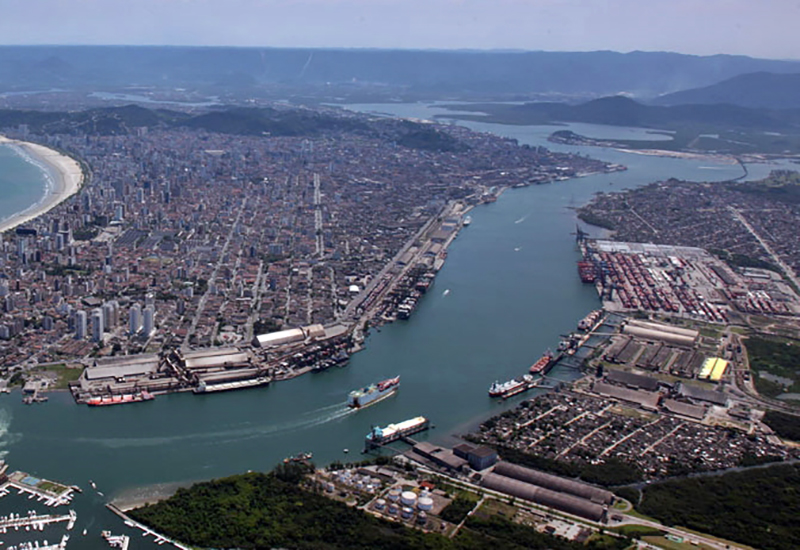

Global shipping leaders Maersk and MSC are preparing to compete for the concession to operate the Tecon Santos 10 container terminal at the Port of Santos, Brazil’s largest port, as uncertainty persists over the auction rules and the impact of Brazil’s upcoming presidential elections on the project’s timeline.
The Brazilian federal government plans to auction the concession later this year. The project is expected to attract investments of approximately 6.45 billion reais (US$1.26 billion). Covering 621,975 square metres, Tecon Santos 10 will be granted under a 25-year concession, making it one of the country’s most significant port infrastructure projects.
Further content is only available for registered users.
However, the proposed auction has sparked disagreement within the government. The Ministry of Ports and Airports and the Civil House support an open bidding process with no restrictions on participation. In contrast, the National Waterway Transportation Agency (Antaq) and the Federal Court of Accounts (TCU) argue that existing terminal operators at the Port of Santos should face limitations to prevent excessive market concentration.
Alongside Maersk and MSC, other incumbent operators with potential interest include France’s CMA CGM, which controls Santos Brasil, and DP World. If participation restrictions are maintained, some of these established operators could be excluded from the bidding process.
The project has also attracted interest from several companies that do not currently operate at the Port of Santos. These include Singapore’s PSA, US-based Hudson Ports, China’s Cosco, Brazil’s J&F and CSN, Japan’s Ocean Network Express, Germany’s Hapag-Lloyd, the Philippines’ ICTSI, and South Korea’s Hyundai Merchant Marine.
To strengthen its position ahead of the auction, Maersk and MSC have notified Brazil’s competition authority (Cade) of a potential restructuring of their joint ownership of Brasil Terminal Portuário (BTP). BTP is currently owned equally by APM Terminals, Maersk’s port operating division, and MSC’s Terminal Investment Limited (TiL).
According to APM Terminals, the company has requested Cade’s approval for a transaction that would allow it either to acquire TiL’s 50% stake in BTP or to sell its own 50% holding, depending on the outcome of the Tecon Santos 10 auction. The company stated that no decision has yet been made regarding which course of action it will pursue.
APM Terminals also noted that the Investment Partnerships Program (PPI), overseen by the Civil House, allows existing container terminal operators at the Port of Santos to be treated as non-incumbent bidders, provided they commit in advance to divesting their interest in another terminal if they secure the new concession.
While the government continues to target an auction this year, industry participants believe Brazil’s October presidential elections may delay the process. As political attention shifts toward the election campaign, important regulatory decisions could be postponed, increasing uncertainty for potential investors.
According to recent opinion polls, the presidential race remains closely contested between incumbent President Luiz Inácio Lula da Silva and Senator Flávio Bolsonaro, son of former President Jair Bolsonaro.
One lawyer advising a foreign company considering a bid for Tecon Santos 10 said the election outcome could have a significant impact on the project’s future. In the lawyer’s view, a Lula victory would likely allow the auction to proceed, whereas a change in government could result in a broader review of the project. Under the previous Bolsonaro administration, the priority had been the full privatisation of the Port of Santos authority rather than the standalone development of Tecon Santos 10.